
 English
Before unveiling the full scores and complete review in the coming days, let’s take a closer look at how the Samsung Galaxy S26 Ultra performs in several key areas compared with other ultra-premium smartphones, including the iPhone 17 Pro and the Motorola Signature. Samsung has introduced a number of improvements over the previous generation, but some gaps still remain when measured against the latest flagship competitors.
Low-Light Performance
The Galaxy S26 Ultra brings a few hardware updates, including a wider aperture on the main camera and a new 5× telephoto lens. These changes help the camera capture more light, which improves performance in difficult conditions such as low-light photography and video.
Together with Samsung’s Pro Scaler technology, the phone shows better noise control and a more balanced level of detail compared with the Galaxy S25 Ultra. Images taken in low light look cleaner overall, especially when slightly zooming in on the main camera.
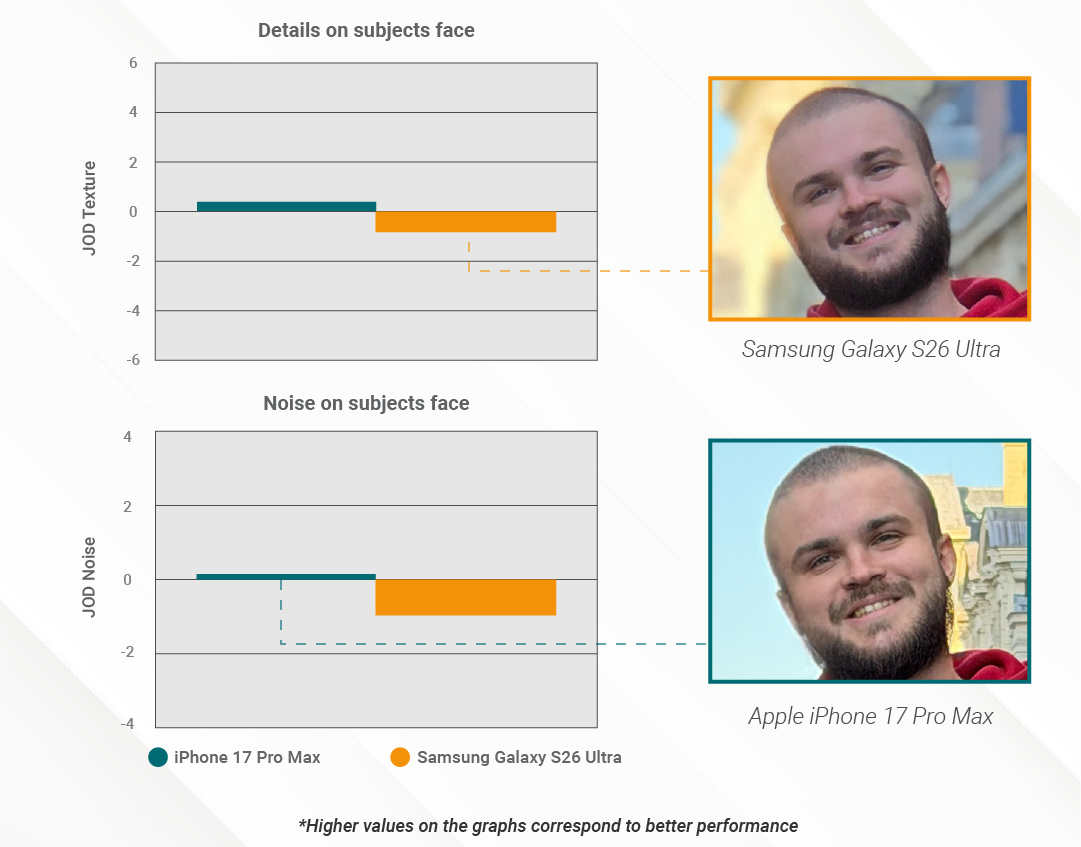
Despite these improvements, the S26 Ultra still trails the iPhone 17 Pro in challenging low-light scenes. In our comparisons, Samsung’s device showed more visible luminance noise and slightly less detail in portraits captured in dim environments.

Portrait Photography: Building on the Previous Generation
Portrait performance has improved compared with the Galaxy S25 Ultra. The previous model often struggled with color accuracy in difficult lighting, sometimes producing unnatural skin tones. With the S26 Ultra, Samsung appears to have addressed this issue. Face brightness is also fairly similar between Samsung and Apple devices. In some lower-contrast scenes, the S26 Ultra even applies a slightly stronger brightness boost to faces, which may help portraits appear more flattering.


Areas for Improvement
Even with these improvements, the S26 Ultra still faces some challenges in portrait photography. Our tests revealed occasional autofocus inconsistencies, particularly in low light or complex lighting situations. When focus is slightly off, facial details can appear softer and exposure on the face may be less accurate.
Portrait mode (bokeh) is another area where the phone still struggles to match the best devices in the segment. Images sometimes show lower clarity and less effective noise reduction compared with competing flagship phones. Subject separation can also be inconsistent. In some scenes, small segmentation errors appear around the edges of the subject, creating visible gaps between the person and the blurred background.


Zoom Remains a Key Strength
One area where the Galaxy S26 Ultra continues to perform very well is zoom. Thanks to its dual telephoto system, the phone delivers strong results across many zoom levels in both photo and video.
In many situations, the S26 Ultra still preserves slightly more detail than the iPhone 17 Pro. However, competitors are quickly closing the gap. Motorola’s Signature flagship, for example, performs particularly well in medium-range telephoto portraits around 3× zoom, where it preserves more facial texture and detail than the Samsung device.


Initial Assessment
In this quick review comparing its performance with other major flagship smartphones, we’ve seen that the Samsung Galaxy S26 Ultra brings noticeable improvements over the previous generation, particularly in low-light capture, noise control, and skin-tone rendering. These refinements make it a more capable device for portrait photography, although some limitations remain. Competing flagship smartphones still deliver cleaner low-light portraits, more consistent subject separation, and stronger detail in certain zoom scenarios.
Overall, the Galaxy S26 Ultra remains a strong contender especially for zoom photography but it now faces increasingly strong competition in portrait and low-light imaging within the ultra-premium segment.
A full evaluation, including detailed scores and a complete analysis of the camera performance, will be published soon so stay tuned for the full review.